2 Days
Advanced Prompting Strategies
This course is designed for professionals and advanced learners who have foundational prompting skills and are ready to level up. Learn advanced techniques and strategic workflows to control how the AI tool behaves and automate complex tasks.







Scroll Down
Join our pool of over
105,977+ learners
105,977+ learners
Rated 4.4 on 
with over 11,800 reviews

with over 11,800 reviews
Course Overview
Knowing how to use ChatGPT is one thing, but knowing how to leverage them to automate workflows, create reports and extract precise, structured information from massive datasets is another.
In this 2-day Advanced Prompting Strategies course, you'll learn how to go beyond the basics with proven strategies used by subject-matter experts to upload or input extensive data (like sales reports, survey results, marketing reports or bank statements) and prompt AI to generate concise, visually clear summaries in the form of charts, graphs, or key statistics. You'll also develop the ability to feed AI small amounts of structured data (such as bullet points or short notes) and prompt it to expand that information into full, useful outputs such as contracts, job descriptions or travel itineraries.
In this 2-day Advanced Prompting Strategies course, you'll learn how to go beyond the basics with proven strategies used by subject-matter experts to upload or input extensive data (like sales reports, survey results, marketing reports or bank statements) and prompt AI to generate concise, visually clear summaries in the form of charts, graphs, or key statistics. You'll also develop the ability to feed AI small amounts of structured data (such as bullet points or short notes) and prompt it to expand that information into full, useful outputs such as contracts, job descriptions or travel itineraries.
Platforms & Tools Introduced


Course Highlights
- Set a "Persistent Professional Persona" (e.g. instructing the AI to act as a senior marketing analyst ) on ChatGPT so that the model maintains the correct tone, expertise, and focus in the same conversation, eliminating the need to re-prompt, remind, or repeat your initial instructions.
- Instruct AI Tools like Claude or ChatGPT to quickly process large volumes of text based on detailed news articles or lengthy market research reports, and instantly deliver the key takeaways as clean, actionable, structured data in your preferred format (e.g., summary tables or priority bullet points) for faster analysis and decision-making.
- Upload or input raw transactional data (e.g., information from a bank statement or expense spreadsheet) and generate a neatly categorised, structured financial output, such as a precise personal budget table, eliminating manual data entry and ensuring effortless tracking.
- Execute basic troubleshooting procedures for common AI tool issues by applying Chain-of-Thought (CoT) and Self-Correction Loops to ensure error-free and logically sound outputs for complex tasks, which drastically reduces time required for manual validation.
- Learn how to prevent AI hacking (Prompt Injection Defense) to secure internal tools (e.g., stopping a malicious user from leaking data via an employee chatbot) and apply Bias Mitigation to ensure all generated output is ethically compliant and prevent costly breaches.
Learning Outcomes
By the end of this course, you'll be able to:
- Grasp the core principles of prompt engineering, including the relationship between your prompt design, the AI model's behavior, and the diversity of its outputs.
- Employ various prompt techniques tailored for diverse use cases, optimising your interactions with AI for specific tasks.
- Identify potential misuses of prompts, ensuring you interact with AI safely and ethically while minimising risks.
- Master general best practices for engaging with Foundation Models, understanding their characteristics and limitations to maximise their utility.
- Apply theoretical frameworks to determine the most suitable prompt techniques for different Foundation Models and ensure optimal performance and results.
- Craft sophisticated prompt structures and leverage specific word usage to apply advanced prompt engineering techniques and influence AI outputs with precision.
- Analyse and mitigate potential biases in Foundation Model responses by designing targeted, corrective prompts.
Competency Assessment
Written and Practical Assessments
Stand Out From The Competition With Professional Certificates
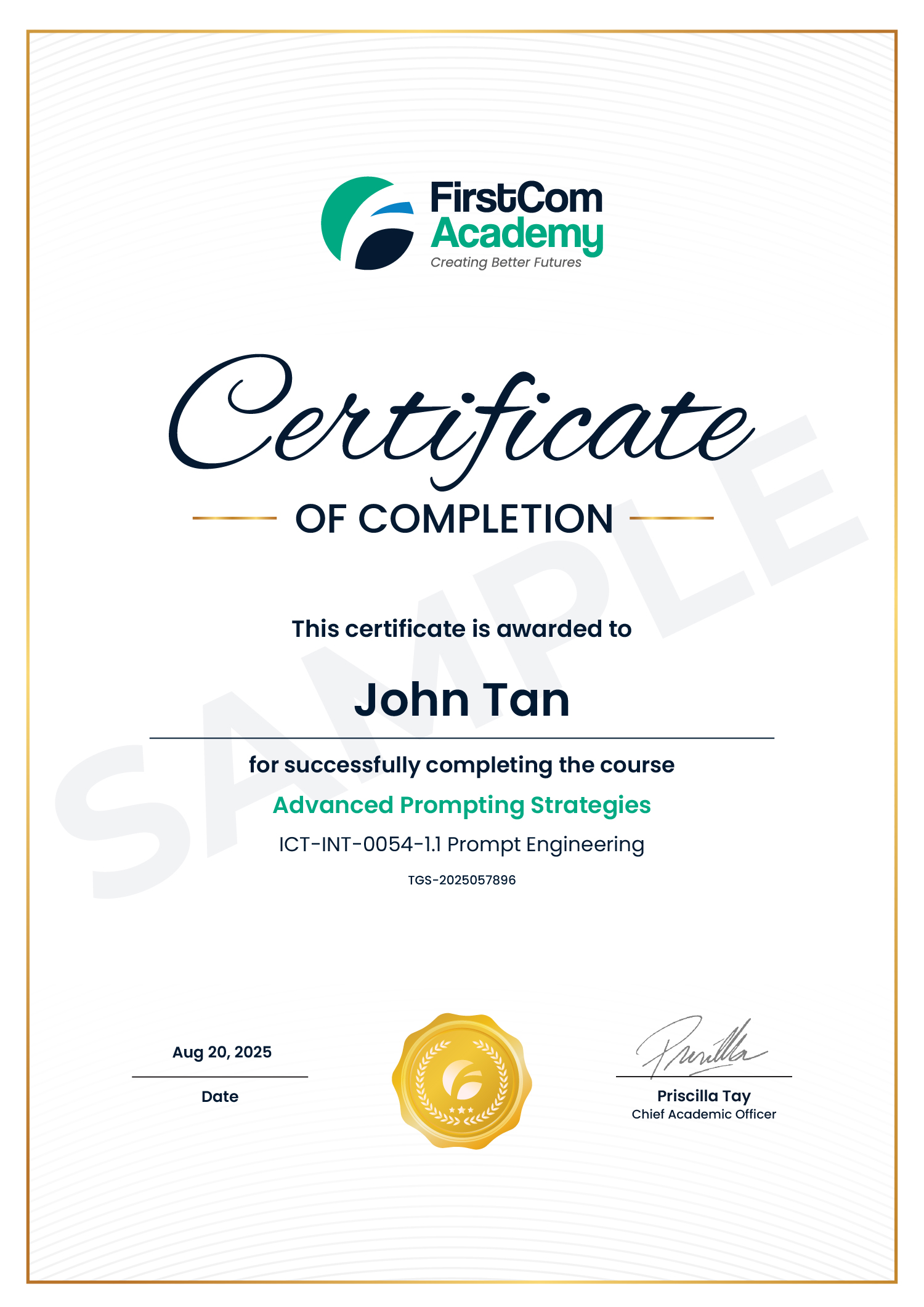
Candidates who complete each module with at least 75% attendance and demonstrate competency during assessment will receive a Certificate of Completion by FirstCom Academy and a WSQ Statement of Attainment.


Entry Requirements:
- Aged 21 and above
- Have basic computer literacy Level 2
- Have minimum GCE “N”, “O” or “A” Level / NITEC or a diploma qualification and minimum 2 years of working experience; and
- Have an English language proficiency equivalent of higher of any of the following – GCSE N/O Levels pass in English / WPLN Level 5 / IELTS 5.5 / TOEFL (internet based total) 46-59
Enquire About Our Courses
Ready to Upskill? We’re here to Support You.
Advanced Prompting Strategies
TGS-2025057896
The course fee will be automatically subsidized during the online enrollment process.
Full Course Fee
(with 9% GST)
(with 9% GST)
Fee & Subsidy
Breakdown
Breakdown

Mode of training:
Classroom

Duration:
2 Days

Course Accreditation:
WSQ
Loading...

!
 Select Date
- Available
- Selling Fast
- Full Enrollment
Please select a course date
Your training location is at FirstCom Academy
Course Timing for
Course Fees & Subsidies
| SMEs | |
| Course Fees | |
| 70% SkillsFuture (SSG) Subsidy | |
| Nett Fee | |
| Non SMEs | |
| Course Fees | |
| 50% SkillsFuture (SSG) Subsidy | |
| Nett Fee | |
| Additional Support | ||||
|
Additional Support via Absentee Payroll |
||||
|
||||
|
Up to 90% Additional Subsidy from SkillsFuture Enterprise Credit (SFEC) |
||||
- Nett Fee is subject to 9% GST charged based on the full course fees before subsidy.
- Absentee payroll is claimable up to $4.50 per hour, capped at $100,000 per enterprise per calendar year.
- Subjected to individual company’s budget availability for the Enterprise Innovation Scheme. Each company can only either the 400% Tax Deduction option OR the 20% Cash Payout option. For more information, please refer to https://www.iras.gov.sg/schemes/disbursement-schemes/enterprise-innovation-scheme-(eis)
- Subjected to individual company’s budget availability for SFEC. For more information, please refer to https://www.enterprisejobskills.gov.sg/content/upgrade-skills/sfec.html
SME Eligibility Criteria
- Registered or incorporated in Singapore
- Employment size of not more than 200 (at group level) or with annual sales turnover (at group level) of not more than $100 million
| Singapore Citizens (40 years and above) | |
| Course Fees (Before GST) | |
| 9% GST | |
| 70% SkillsFuture (SSG) Subsidy | |
| Nett Fee | |
| Singapore Citizens (21-39 years old) & PR | |
| Course Fees (Before GST) | |
| 9% GST | |
| 50% SkillsFuture (SSG) Subsidy | |
| Nett Fee | |
| Additional Support | |
|
SkillsFuture Credits eligible for Singapore citizens aged 25 & above |
|
|
PSEA eligible for Singapore citizens aged below 30 |
|
|
NTUC UTAP members can have up to 50% reimbursement on out-of-pocket cost |
|
- Nett Fee are inclusive of GST charged based on the full course fees.
- Subjected to individual’s eligibility and availability of SkillsFuture Credit.
- NTUC UTAP reimbursement is capped at $250 for members aged below 40 or $500 for members aged 40 & above.