2 Days
Effective Prompting Fundamentals
Learn how to craft clear, strategic prompts to unlock the full potential of AI tools like ChatGPT, Microsoft Copilot, and Gemini. This 2-day course is ideal for professionals, content creators or anyone who wants to use AI more effectively for everyday work and personal productivity.









Scroll Down
Join our pool of over
105,977+ learners
105,977+ learners
Rated 4.4 on 
with over 11,800 reviews

with over 11,800 reviews
Course Overview
AI tools are only as good as the prompts they receive. Whether you're drafting emails, creating reports, analysing data, or generating creative visual content, knowing how to structure your prompts can be the difference between average and exceptional results.
Effective Prompting Fundamentals is a beginner-friendly, hands-on course designed to teach you the core principles of prompting so you can maximise the value of AI tools in both personal and professional contexts. You’ll learn easy-to-apply frameworks like ReAct, CLEAR, SAFE, and PREP to write more precise, reliable, and secure prompts across a wide range of use cases.
From minimising errors to protecting data and troubleshooting common issues, this course empowers you to work smarter, faster, and more confidently with AI — no technical background required.
Effective Prompting Fundamentals is a beginner-friendly, hands-on course designed to teach you the core principles of prompting so you can maximise the value of AI tools in both personal and professional contexts. You’ll learn easy-to-apply frameworks like ReAct, CLEAR, SAFE, and PREP to write more precise, reliable, and secure prompts across a wide range of use cases.
From minimising errors to protecting data and troubleshooting common issues, this course empowers you to work smarter, faster, and more confidently with AI — no technical background required.
Platforms & Tools Introduced

Course Highlights
- Design effective prompts using the ReAct (Reason + Act) Framework to improve the quality and relevance of AI-generated responses.
- Structure your prompts with the CLEAR Framework by incorporating context, language, examples, action, and relevance for sharper, more accurate outputs.
- Protect sensitive information using SAFE Prompting with basic anonymisation techniques like sanitising, abstracting, filtering, and encrypting data.
- Implement prompt guardrails to filter problematic inputs and avoid unwanted or unpredictable AI outputs.
- Troubleshoot common AI tool issues using the PREP (Problem, Reproduce, Evaluate, Patch) Framework to maintain consistent and reliable tool performance.
- Use zero-shot, one-shot, few-shot, and domain-specific strategies to adapt your prompts for various use cases and get optimal results.
- Analyse real-world prompt examples and misuses to understand what works, what doesn’t, and how to fine-tune your prompt designs for different goals.
Learning Outcomes
By the end of this course, you'll be able to:
- Understand Prompt Design Principles: Learn about the core principles of prompt design and how prompts shape AI-generated content. You'll discover fundamental prompt design techniques that lay the groundwork for effective AI interaction.
- Ensure Responsible AI Usage: Understand data privacy regulations and learn to apply basic anonymisation techniques (like data masking and pseudonymisation). You'll also learn about guardrails to prevent prompts from creating unexpected outputs and how to implement them, along with following standard troubleshooting procedures for safety.
- Troubleshoot AI Tool Issues: Learn techniques in troubleshooting AI tools, enabling you to effectively recognise issues encountered with AI tools and execute basic troubleshooting procedures to resolve common problems.
- Construct Effective Prompts: Gain understanding of the concept of prompt design and learn to define the fundamental elements of a prompt. You'll learn various techniques in prompt construction (e.g., zero-shot prompting, one-shot prompting, chain-of-thought prompting, instruction prompting, and using hyper-parameters). The course also covers how to identify best practices for designing effective prompts.
- Analyze and Evaluate AI Outputs: Learn about the impact of prompts on different modes of AI output. You'll gain the ability to identify common prompt misuses (e.g., lack of context, vague instructions) and associated risks. Crucially, you'll be able to compare prompt designs and corresponding AI outputs to ascertain their suitability for various use cases and domains.
- This course equips you with essential prompting techniques and AI interaction skills that are increasingly in demand in today’s job market.
Competency Assessment
Written and Practical Assessments
Stand Out From The Competition With Professional Certificates
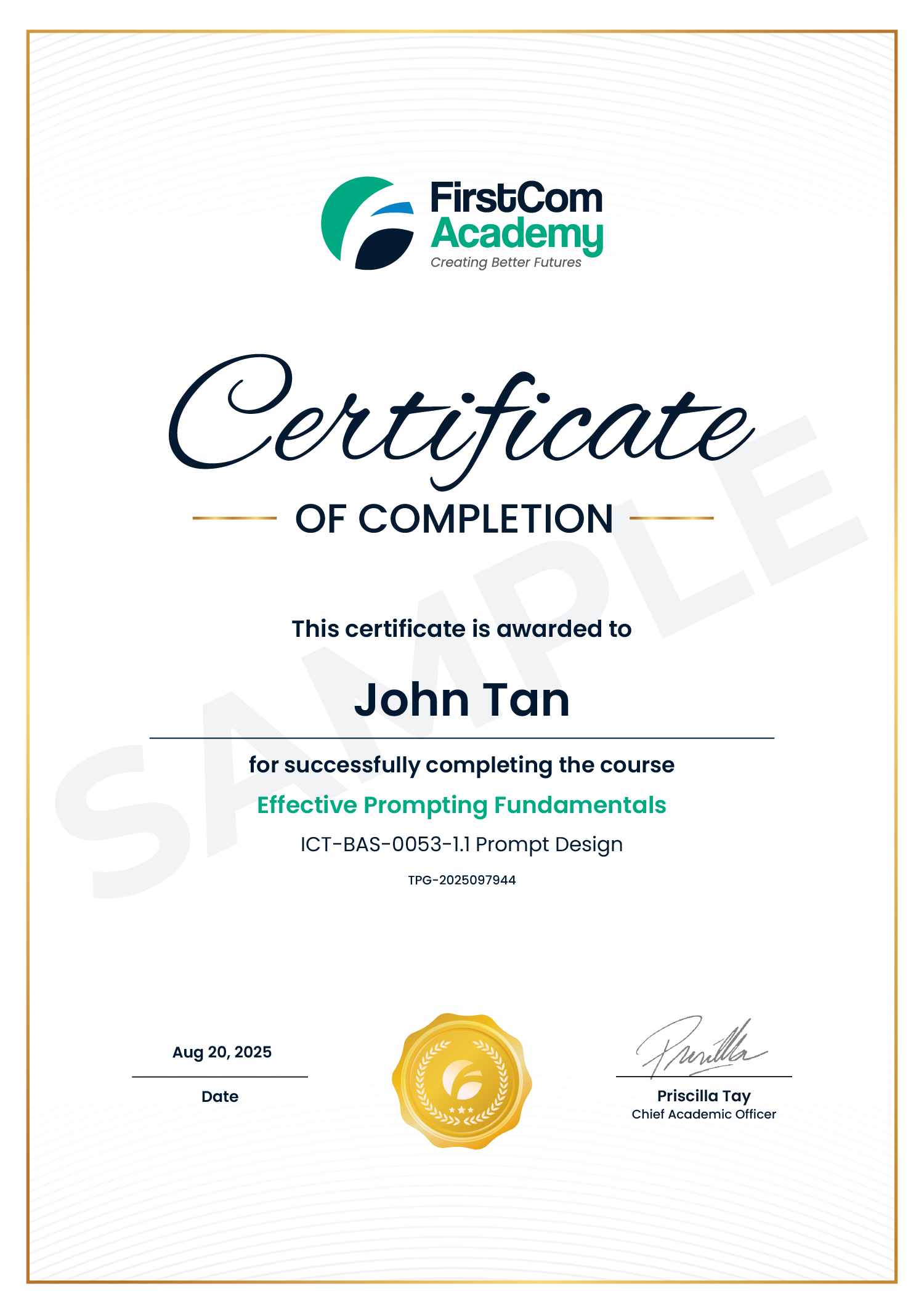
Candidates who complete each module with at least 75% attendance and demonstrate competency during assessment will receive a Certificate of Completion by FirstCom Academy and a WSQ Statement of Attainment.


Entry Requirements:
- Aged 21 and above
- Have basic computer literacy Level 2
- Have minimum GCE “N”, “O” or “A” Level / NITEC or a diploma qualification and minimum 2 years of working experience; and
- Have an English language proficiency equivalent of higher of any of the following – GCSE N/O Levels pass in English / WPLN Level 5 / IELTS 5.5 / TOEFL (internet based total) 46-59
Enquire About Our Courses
Ready to Upskill? We’re here to Support You.
Effective Prompting Fundamentals
TGS-2025057983
The course fee will be automatically subsidized during the online enrollment process.
Full Course Fee
(with 9% GST)
(with 9% GST)
Fee & Subsidy
Breakdown
Breakdown

Mode of training:
Classroom

Duration:
2 Days

Course Accreditation:
WSQ
Loading...

!
 Select Date
- Available
- Selling Fast
- Full Enrollment
Please select a course date
Your training location is at FirstCom Academy
Course Timing for
Course Fees & Subsidies
| SMEs | |
| Course Fees | |
| 70% SkillsFuture (SSG) Subsidy | |
| Nett Fee | |
| Non SMEs | |
| Course Fees | |
| 50% SkillsFuture (SSG) Subsidy | |
| Nett Fee | |
| Additional Support | ||||
|
Additional Support via Absentee Payroll |
||||
|
||||
|
Up to 90% Additional Subsidy from SkillsFuture Enterprise Credit (SFEC) |
||||
- Nett Fee is subject to 9% GST charged based on the full course fees before subsidy.
- Absentee payroll is claimable up to $4.50 per hour, capped at $100,000 per enterprise per calendar year.
- Subjected to individual company’s budget availability for the Enterprise Innovation Scheme. Each company can only either the 400% Tax Deduction option OR the 20% Cash Payout option. For more information, please refer to https://www.iras.gov.sg/schemes/disbursement-schemes/enterprise-innovation-scheme-(eis)
- Subjected to individual company’s budget availability for SFEC. For more information, please refer to https://www.enterprisejobskills.gov.sg/content/upgrade-skills/sfec.html
SME Eligibility Criteria
- Registered or incorporated in Singapore
- Employment size of not more than 200 (at group level) or with annual sales turnover (at group level) of not more than $100 million
| Singapore Citizens (40 years and above) | |
| Course Fees (Before GST) | |
| 9% GST | |
| 70% SkillsFuture (SSG) Subsidy | |
| Nett Fee | |
| Singapore Citizens (21-39 years old) & PR | |
| Course Fees (Before GST) | |
| 9% GST | |
| 50% SkillsFuture (SSG) Subsidy | |
| Nett Fee | |
| Additional Support | |
|
SkillsFuture Credits eligible for Singapore citizens aged 25 & above |
|
|
PSEA eligible for Singapore citizens aged below 30 |
|
|
NTUC UTAP members can have up to 50% reimbursement on out-of-pocket cost |
|
- Nett Fee are inclusive of GST charged based on the full course fees.
- Subjected to individual’s eligibility and availability of SkillsFuture Credit.
- NTUC UTAP reimbursement is capped at $250 for members aged below 40 or $500 for members aged 40 & above.